
Opal Types Explained: Black, White, Boulder and Crystal Opal Compared
Opal is the gemstone that refuses to sit still. Tilt a good stone under a lamp and the colours shift, flare and vanish. Buy a second stone of the same type and it will behave differently again. That variability is what makes opal so appealing, and also what makes shopping for it confusing — especially when the labels start flying around: black, white, boulder, crystal.
The truth is that these names describe two separate things. Some refer to the background tone of the stone. Others describe what the opal is attached to, or how transparent it is. Once you separate those ideas, the whole category becomes much easier to read.
The basic building blocks: tone, body and back
Three features decide which family an opal belongs to.
- Body tone — how dark the background of the stone is, from jet black through grey to milky white.
- Transparency — whether you can see through the stone (crystal) or not (opaque).
- Host rock — whether the opal sits on the ironstone or sandstone it formed in (boulder opal), or has been cut free of it.
Those three variables combine in different ways, which is why a black opal can also be a crystal opal, and why boulder opal is a category almost unto itself.
Black opal: the dark background that makes colour shout
Black opal has a dark body tone, usually deep grey to near-black, with a vivid play of colour sitting on top. The contrast is the whole point. Reds, greens and blues look brighter and more saturated against a dark background than they ever could against a pale one.
The best-known source is Lightning Ridge in New South Wales, Australia, which has produced most of the world's finest black opals. Genuine black opal is rare, and the price reflects that. A small, bright black opal with strong red flashes can cost many times more than a much larger white opal of similar pattern and brightness. Black opal also tends to be reasonably durable when cut sensibly, though any opal is softer than sapphire or diamond and deserves protective setting.
Best uses for black opal
Rings, pendants and statement earrings. The colours read well from a distance, so black opal works for pieces meant to be noticed. In a ring, choose a bezel or a low-profile setting so the stone's edges are protected from knocks.
White opal: the classic milky look
White opal — sometimes simply called light opal — has a pale, milky body with flashes of colour across it. It is the opal most people picture: creamy, soft, and often cut as a cabochon for a pendant or a pair of studs.
It is also the most abundant of the fine opal types, largely thanks to the Coober Pedy fields in South Australia. That abundance is good news for buyers. White opal gives you real play of colour at prices far below black opal, which makes it the sensible first purchase for anyone testing whether they love the stone.
The trade-off is contrast. On a white background, colours can look washed out under weak indoor light. Hold a white opal near a window before you buy and see how much colour survives. A stone that only sparkles under a jeweller's spotlight may disappoint at home.
Best uses for white opal
Earrings, delicate pendants, bracelets and vintage-style settings. It suits yellow gold, which warms the milky body, and looks clean and modern in silver or white gold.
Boulder opal: colour on ironstone
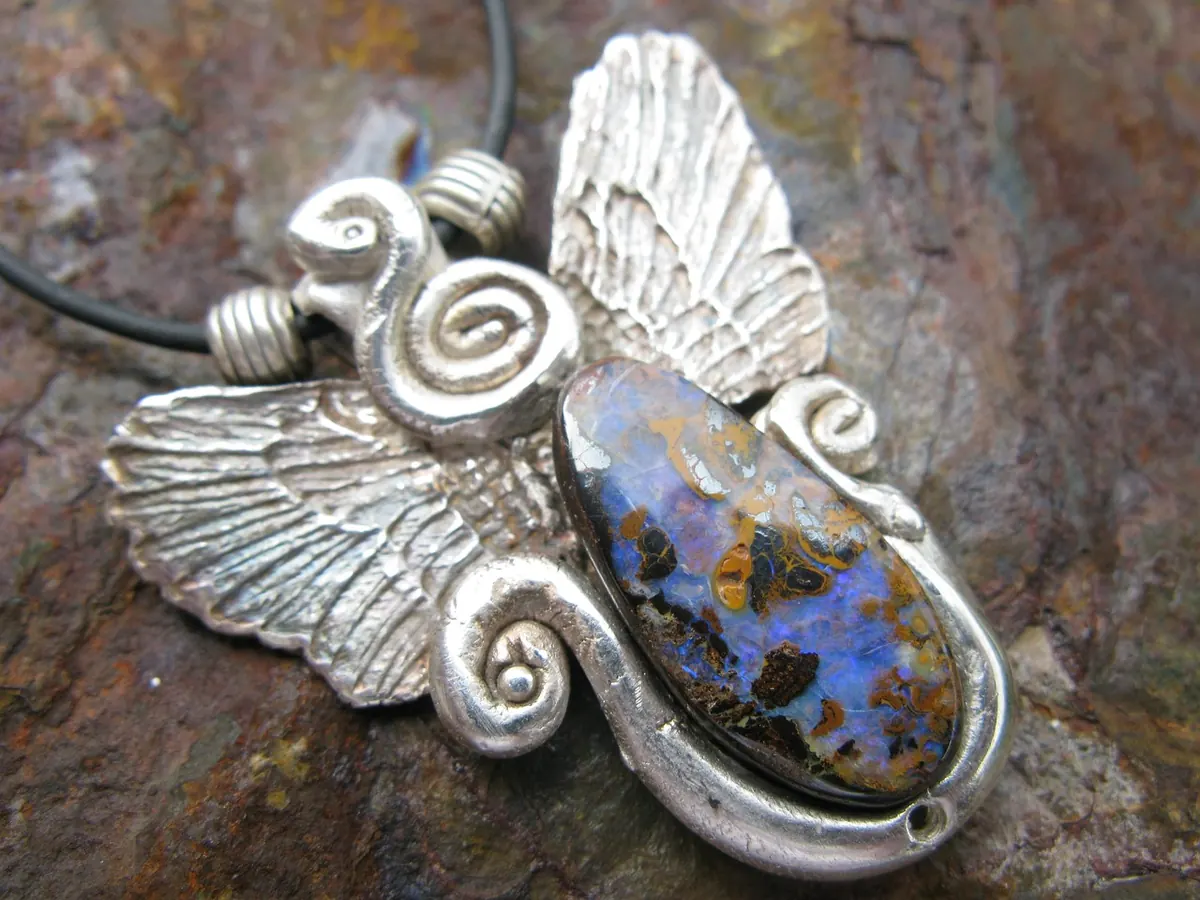
Boulder opal is cut with its natural host rock still attached. The opal typically forms in thin seams and patches inside ironstone, so the cutter follows the colour and leaves a dark brown backing behind it. That backing acts like a built-in dark background, which is why boulder opal can show colour intensity approaching black opal while costing considerably less.
The look is earthy and organic. You get irregular shapes, visible matrix and a one-of-a-kind silhouette, since no two pieces of host rock break the same way. Queensland is the main producing region, with fields such as Winton and Quilpie known for boulder material.
A word of caution. Because boulder opal is part opal and part rock, it can be drilled and carved in ways solid opal cannot, but it can also be faked. If the ironstone looks painted on, or the colour appears as a flat printed layer, walk away.
Best uses for boulder opal
Men's rings, chunky pendants, cufflinks and freeform designs. The ironstone adds weight, so boulder opal suits bolder metalwork rather than fine, lacy settings.
Crystal opal: transparency you can see through
Crystal opal is transparent or semi-transparent, with the colour appearing to float inside a clear or lightly tinted body. The effect is glassy and almost liquid, quite different from the solid look of white opal.
It comes in light and dark versions, so crystal is really a description of clarity rather than colour. A dark crystal opal from Lightning Ridge, for example, can be spectacular: transparent, dark and brilliantly patterned all at once.
Crystal opal is generally cut with a lower dome than other opals, because the colour sits close to the surface. That makes the finished stone look flatter, and it also makes the material a little more vulnerable to scratching and chipping. Careful wear matters here.
Best uses for crystal opal
Pendants, earrings, dress rings and any setting where the stone can be admired up close. Because transparency shows both faces of the stone, crystal opal is often best set with an open back so light can pass through.
What actually drives the price
Type matters, but it is not the whole story. Two black opals of the same size can differ enormously in value. The factors buyers weigh are:
- Brightness — how strongly the colour flashes in ordinary light, not just under a lamp.
- Pattern — rolling flash, harlequin, flagstone and floral patterns are prized; broad, plain flashes less so.
- Colour range — red on black is the most sought after, followed by orange, green and blue.
- Body tone — the darker the background, generally the higher the price.
- Size and cut — larger, well-proportioned stones with a high, even dome command more.
- Treatment — solid, untreated natural opal is worth more than doublets or triplets, which are assembled stones with a thin opal layer glued to a backing.
As a rough guide rather than a rule, white opal sits at the affordable end, crystal and boulder in the middle, and solid black opal at the top. Always ask whether a stone is solid, a doublet or a triplet, and get it in writing.
Buying advice that saves disappointment
Look at any opal in three lights: bright daylight, ordinary room light, and a dim corner. If you still like it in all three, it is a good stone. Ask to see the back of the setting — a solid opal should not have a glued join. And consider how you live: an opal ring worn daily for gardening, gym sessions and washing up will not last as well as one worn for evenings out.
Opal is softer than most coloured gems, so store it separately from harder stones and take rings off before heavy work. If you are spending serious money, buy from a seller who will confirm the type, origin and whether the stone is solid, and get an independent valuation for insurance.
Quick comparison at a glance
- Black opal — dark body, vivid contrast, highest prices, best in statement rings.
- White opal — milky body, gentle colour, most affordable, best in earrings and pendants.
- Boulder opal — opal on ironstone, earthy and unique, best in bold men's and unisex designs.
- Crystal opal — transparent body, floating colour, best in pendants and pieces set with an open back.
None of these is better than the others outright. A quiet white opal pendant can be lovelier than a mediocre black opal, and a well-cut boulder stone often beats both for character. Buy the stone that looks alive to you, and let the label be a guide rather than the deciding vote.
Photo: artesilver2 / Pixabay